
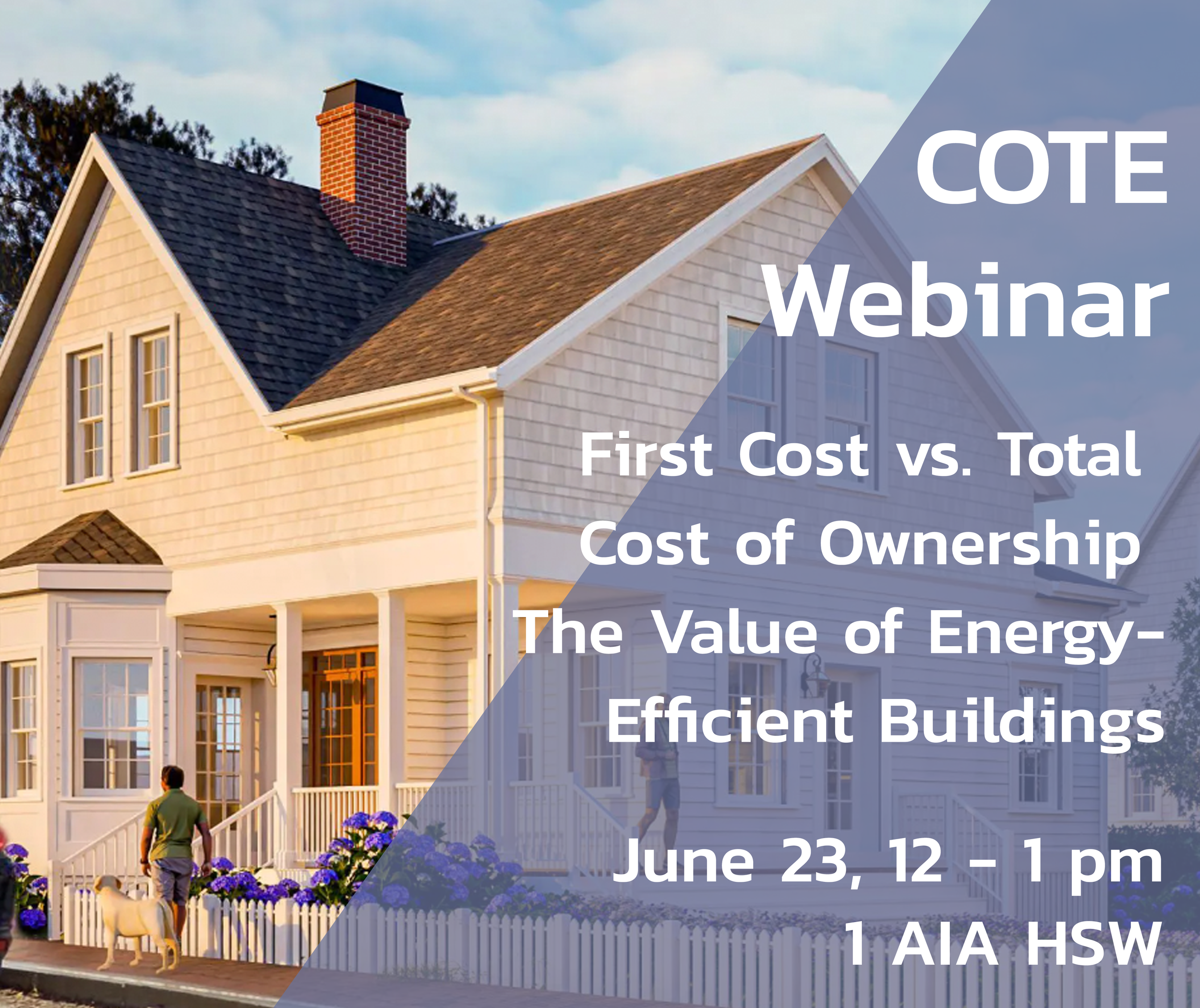
AIANH COTE (Committee on the Environment) Webinar
First Cost vs. Total Cost of Ownership: The Value of Energy-Efficient Buildings
Building design decisions in New Hampshire are often driven primarily by initial or “first-cost” considerations for residential and commercial construction. However, as energy costs continue to rise, the long-term operating cost of a building becomes increasingly important. A Total Cost of Ownership (TCO) approach evaluates both upfront construction costs and the ongoing energy and operational expenses over the life of the building, providing a more complete basis for decision-making.
This webinar will present a comparative review of two New Hampshire building projects in which both first cost and total cost of ownership were analyzed. The discussion will highlight how energy-efficient design strategies and modern building codes can result in only modest increases in initial construction costs while significantly reducing long-term ownership expenses.
The objective analysis presented is intended to help builders, developers, and property owners better understand the growing value of energy efficiency and the economic benefits of higher-performance building design.
Learning Objectives:
Understanding the difference between first cost and total cost of ownership (TCO) in building design Participants will learn how initial construction costs compare to long-term operational and energy expenses over the life of a building.
How to evaluate the impact of energy-efficient design strategies on long-term building economics Attendees will review case studies demonstrating how improved building performance can reduce operating costs and increase overall value.
Recognizing how modern energy codes influence construction cost and lifecycle savings Participants will gain insight into the relationship between updated energy codes, incremental first-cost increases, and long-term financial benefits.
How to apply lifecycle cost analysis concepts to residential and commercial building decisions Attendees will learn how total cost of ownership analysis can support more informed decisions for building owners, developers, designers, and contractors.
Ideal for architects, builders, engineers, code officials, developers, sustainability professionals, and anyone involved in housing and energy policy in New Hampshire.
PRESENTER

Paul Bemis is President and CEO of Applied Math Modeling. He has over 30 years of involvement in engineering design and has held executive positions at both the ANSYS and Fluent Corporations. He helped lead the application of engineering simulation tools for predicting design performance, utilizing Finite Element Analysis (FEA) and Computational Fluid Dynamics (CFD), in the fields of Aerospace and Automotive design. His work at Applied Math Modeling is focused on bringing those same skills and technology to the Built Environment. Mr. Bemis has a BSME, MSEE, MBA, and is the President of the State of New Hampshire ASHRAE (American Society of Heating, Refrigerating and Air-Conditioning Engineers).
This event is free to attend.
1 AIA HSW credit is offered for the course.